Sunday, December 30, 2012

Mothers Protect the People

"Yaw, it is time to wake up. I was thinking we should take a trip and go to Akim Oda to see my mother for a few days. What would you think of that?"  

"Sure, some time at the farm, Nana. I'd like that." I replied, rubbing the sleep out of my eyes.

It was 1986. Nana had struggled to get to where he was at in life, now a Masters Degree candidate and lecturing in the Art Department at Tech.

Nana, his brothers and sisters were raised by a single mother who I knew simply as Auntie Nana.  Nana is not only a proper name for a boy or a girl, but it's also a title used when addressing older people, meaning 'respected one.'  She let me call her Auntie Nana and she smiled when I called her that. Her husband left when the children were very young, so she had to figure out a way to feed her children and to pay their school fees. Buying and selling produce in the market, she saved money over many years and bought land in Akim Oda, northwest of Accra in the Akim land. And on that land she built the most beautiful farm with maize, eggplants, tomatoes, plantain, papaya, bananas and the most gorgeous white pigs.

The Akim are a quiet people, and they tend to keep to themselves. Traditionally they were warriors, but became cocoa farmers during the late 1800's. Akim is hilly with dense rain forest, an incredibly beautiful part of Ghana. I've always enjoyed that part of the country, because of its tranquility and simplicity of life.

We quickly got bathed. Nana shared a flat at Independence Residence Hall at the university with another Masters candidate, but the showers and bathrooms were dormitory style down the hall. We walked down to the showers, carrying our towels, sponges, soap and toothpaste. Nana was concerned about a weaving project he was working on, and asked for my advice as we showered.

After we were clean and shaved, I packed a few t-shirts and a couple pairs of cotton pants, while Nana carried a box of things for his mother we had bought in town; things she wouldn't buy for herself, like imported soap, cocoa butter lotion made in Ghana, biscuits and chocolate. This was during my first visit back to Ghana after 1982, and the economy had vastly improved. The markets in Kumasi were packed with everything imaginable, so it was nice to be able to shop for some things with which Nana's mother could indulge herself. Nana was very close to his mother. Whenever he spoke of her his eyes would light up and that infectious smile would take over.
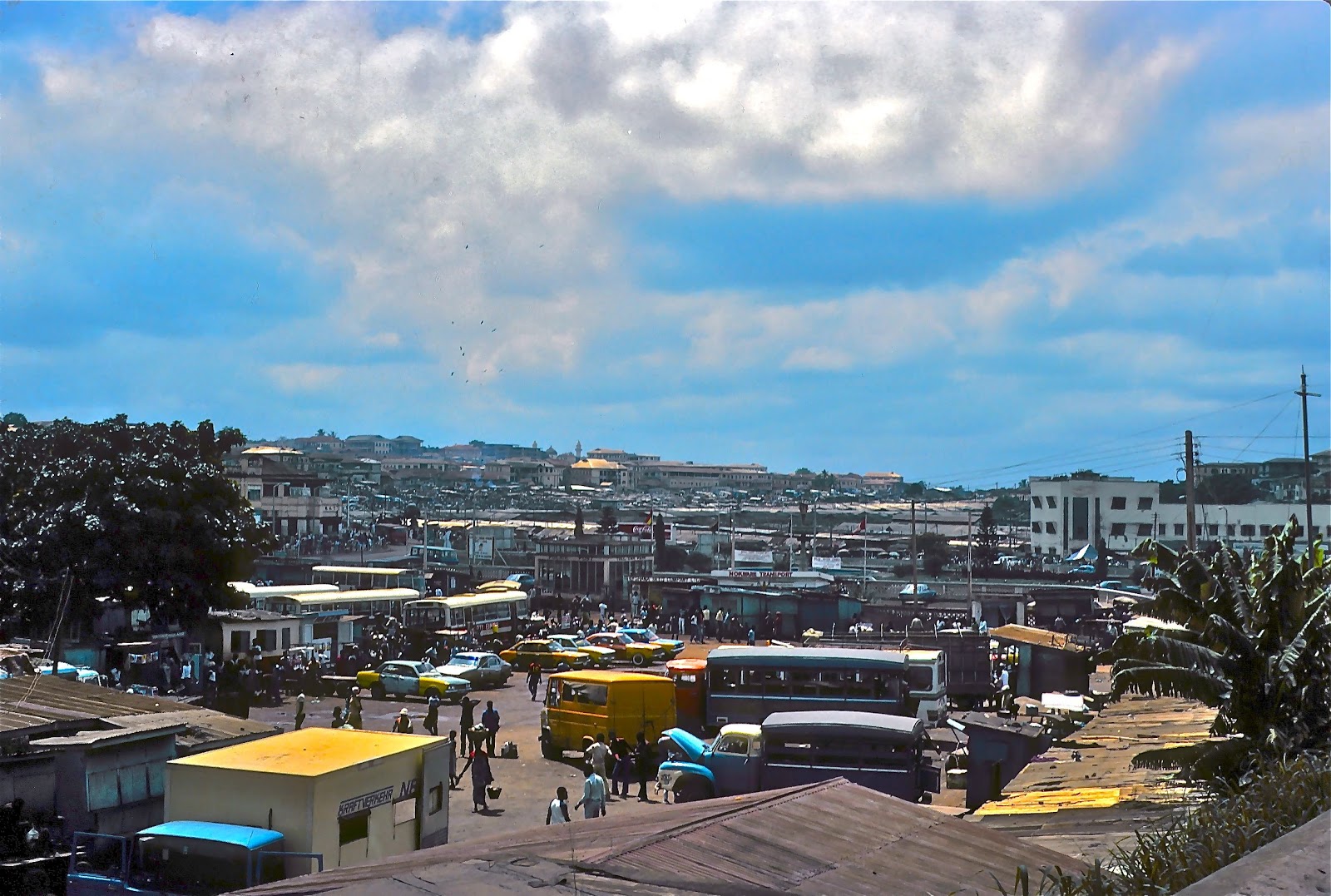

We took a taxi to Kejetia in the center of Kumasi and then walked to the bus yard. The bus yard could be described as controlled chaos with buses lined up in arbitrary rows. The object was to find a bus headed to where you are traveling to. This could be a challenge, since a hundred "mates", or drivers' assistants,  yelled their destination at the same time with a great deal of bravado. "Taaaaaaaaaamale, Tamale, Tamale!" "Cape! Cape! Cape! Cape! Cape!" "Bolgaaaaaaaaatanga, Bolga, Bolga, Bolgataaaaaanga!" "Accra! Accra! Accra! Accra! Accra!" A chorus of a hundred cities' names all being yelled at once. Magically, Nana could hear Akim Oda called out, weaving his way through the maze of buses and Tro-Tros. How he could hear this was baffling to me.

We bought our tickets, got on the bus and then waited for the bus to fill up. Once every seat was taken, it would be time to leave. So Nana and I found our seats and bought some snacks from the market women catering to passengers, carrying their baskets of treats on their heads as they combed through the aisles while yelling, "Meat pies! Kokoo chips! Kwadu ne nkatee! Hard-boiled kosuea! Roasted bayere ne mako! Fried kosuea sandwiches! Bofrort!"

While we sat and ate our fried egg sandwiches, a young man boarded the bus flanked by two older men who were dressed in traditional cloth. I put my sandwich down and froze. The young man was stunningly beautiful - that's the only way to describe him. He was dressed in white robes, with strings of tiny brass bells around his wrists and ankles, chiming as he walked. His gait was so graceful that it was as if his feet did not touch the ground. He had shoulder-length dreadlocks, and the bottom of each lock was dyed a burnt orange color with a polished cowry shell sewn to the end. His forehead, eyes and cheeks were covered with white powder and his neck, arms and ankles were intricately painted with abstract designs made with a white pigment.  He carried a whisk made from the tail of a white goat with a leather handle dyed in intricate patterns.  His neck was laden with strands upon strands of Krobo beads, so high that his neck was not visible.

I watched in awe. "Nana, who is he?" I whispered.

Speaking quietly, Nana explained. "He is an Asante fetish priest from near Kumasi, and still quite young.  At an early age, probably 5 or 6 years old, he was recognized by the elders of his people for having one foot in this world and one foot in the next. Maybe he was able to communicate with the departed or he was able to call their spirits to be present in this world. You understand our belief in Nyame and Nyamewaa, right?"

"Yes," I replied. "The unknowable God appears to mankind as both the male God Nyame and the female Goddess Nyamewaa."

"Exactly. He would have been selected because the elders could see attributes of both Nyame and Nyamewaa in his character. Often these children are naturally adept at music, drumming or dance. They have the ability to heal, are incredibly intuitive and have an innate understanding of the herbal medicines we use."

I asked Nana about what the priest was wearing.

"The bells are to alert the spirits who inhabit the trees and the bush that he is coming, and not to be startled by his presence. His hair and his white robes signify that he is separate from the rest of the community, and that he lives in both this world and the next one.  Cowry shells have traditionally been a sign of royalty because they were very expensive to bring up to the Asante land from the shores in the Ga, Fante and Ewe lands."

"Wow...," I whispered.

Nana patted me on the knee and laughed. "There is much to our culture here, Yaw. It makes me happy that you want to learn more."

The priest and his companions sat a few rows in front of us, and slowly the bus filled up.

I loved riding the buses, filled with people who were coming from the market with produce and livestock like chickens and pygmy goats, businessmen in their suits, students finished with classes and old women returning to their villages after shopping or conducting business in Kumasi. Soon, the engine started and the bus was filled with the sounds of High Life music from the radio as we pulled out of the bus yard and onto the road.

Since the roads were still in disrepair with pot holes or completely washed out, we couldn't use the roads directly to Oda and we had to travel south through Accra, then head west to Winneba along the coast and then north to Akim Oda. I never minded the trips, because it was so beautiful to look out and watch as we wound our way through the rain forest passing villages and towns. It was always easy to make new friends because conversation comes so easily during the ride.

Nana and I never ran out of things to talk about, and on this trip Nana told me about how hard his mother had worked to raise her children.


Women in Ghana are fearless when it comes to the upbringing of their children. Part of this comes from the status that motherhood brings a woman in society. Annie and I were once walking through the Kumasi central market, and we came across a disagreement between two women, arguing over who had selected a tuber of yam. The older woman was clearly in the wrong because we had watched the younger woman pick up the tuber to examine it, and then suddenly the older woman snatched it from her. It escalated into yelling but then suddenly stopped. Instead of asserting her right to the tuber, the younger woman backed down and gave up. Annie said the reason was because she did not have children yet, and therefore her status in society was lower than that of the older women who did have children.

Living in Kumasi was a unique experience because the Asantes are a matrilineal society, bringing much more of an equal status to men and women. This is because inheritance, unlike our American culture, is traced to the mother's side of the family and helps to even out the distribution of wealth by giving the women's side of the family much more economic clout. Even at the level of royalty, women play an influential role. The Asantehene, king of the Asante people, is advised by the Queen Mother who has her own court and her own powerful status in the royal palace.


Powerful women are a part of the history of Ghana. One such woman was Yaa Asantewaa. She was born in 1840, and when her brother the Ejisuhene, king of Ejisu, died in 1894, she used her right as Queen Mother to nominate her own grandson to be the new king. She watched as the British exiled him along with Prempeh I, the Ansantehene, to the Seychelles Islands in 1896 for being a perceived threat to the British colony. To add to this disgrace,  the governor general for the Gold Coast Colony, demanded that the Asante people hand over the Golden Stool which embodied the spirit of the people. It is believed to have been brought down from the heavens by Okomfo Anokye the great priest. A meeting among the Asante leaders was held to discuss ways to get the Asantehene out of exile, and Yaa Asantewaa was so frustrated by their lack of leadership, she stood and said the following:

"Now I see that some of you fear to go forward to fight for our king. If it was in the brave days of Osei Tutu, Okomfo Anokye and Opoku Ware, chiefs would not sit down to see their king to be taken away without firing a shot. No European could have dared speak to chiefs of Asante in the way the governor spoke to you this morning. Is it true that the bravery of Asante is no more? I cannot believe it. It cannot be! I must say this - if you, the men of Asante, will not go forward, then we will. We, the women, will. I shall call upon my fellow women. We will fight! We will fight till the last of us falls in the battlefields."

And with that, she lead the great rebellion of 1900 against the British. Thousands died during the rebellion, as the Asante people attacked the Kumasi Fort where the British Army was isolated for months. She was an incredible leader, and used clever ways to keep the British at bay inside the fort including making small ponds of stagnate water at the foot of the fort walls so that mosquitoes would breed and infect the British soldiers with malaria. After four months, the British governor general had to bring in 1,400 troops to put down the rebellion. Nana Yaa Asantewaa and 15 of her advisers were put into exile with Prempeh I along with the Ejisuhene in the Seychelles. She passed away there October 17, 1921.  Prempeh I and the Ejisuhene were released and allowed to return to Ghana, and Prempeh I demanded that her remains and the remains of the other exiles be returned to Ghana for royal burials.

Nana Yaa Asantewaa is loved in Ghana. In 1960, the Yaa Ansantewaa Secondary School for Girls was established, and in 2000 a week-long centenary celebration was held to honor her leadership and fearlessness in the rebellion. A museum was also dedicated to her in Kwaso near Ejisu. She represents the bravery of so many women in Ghana, and through her inspirational example she opened doors for women to play vital roles in securing the independence of Ghana in 1957 and to guide the country as members of Parliament, and as leaders in public service, education and business.

During 1982, I experienced another uprising led by a queen. As I had said, the Asantes have a strong presence of women leaders among their people in positions of influence and power. One such area of influence is in the markets throughout the country that provide food to the entire population.

A sorority of women known as the yam queens, operate under their own hierarchy of power. Lower queens that may only have influence over one or two markets in a localized area report to and follow the direction of queens higher in the hierarchy. At the top of this sisterhood is the Supreme Yam Queen. She watches the supply and demand for yams, a fundamental staple in the Akan diet. If the market gets flooded with yams causing the price to fall, she will communicate to the lower queens to tell market sellers not to come to the market and effectively reduce the supply to keep the prices up. Conversely, if prices get too high, she will give orders for sellers to bring more product to market and bring down the price. And the most fascinating thing is that in most instances, the yam queens are illiterate. They are able to do complex calculations, keep financial records and keep track of inventories by memory.

As I had previously pointed out, the military government wanted to take control of the marketplace and force controlled pricing. The markets were pretty much bare since the market women simply refused to bring their merchandise to be forced to sell at cut rates. Food was a bit more complicated though. If food was not available and the market women were perceived as being responsible for shortages, the power of the queens would have been usurped. In spite of that risk, the Supreme Yam Queen shut down the entire availability of yams throughout the country to let the military government know to stay out of her business. The masses of people did not turn on her, but rather they became outraged at the military government. She stood her ground and she did not blink, and the military was forced to bow down to her. Do not battle with a Ghanaian woman who has children to educate and feed. You will lose.


The bus arrived late in the afternoon and we walked to Auntie Nana's farm. She was so excited to see us both. She was a beautiful woman, with worn hands from working her land.


She and her daughters prepared a room for Nana and I, and then prepared our baths. A bath in the country is much different because we used a bucket of water, handmade soap and a concrete slab under the stars. This is one of my most fond memories of Ghana, where life is broken down to the most essential parts. It's so simple and I felt so much closer to my soul without the distractions of modern life.There's something magical to stand in the warm tropical air, washing with cool water drawn from a well with a million stars overhead - so close you can almost touch them.


We sat with her in her sitting room, watching television and catching up on all the news about Oda. Auntie Nana was kind and soft spoken, but there was a resilience to her as well. A woman who had worked very hard for many years; life had given her thick skin. She asked me if I had seen his paintings and weaving. We talked a lot about what it was like for me to study at a university in Ghana, and she asked me much about how it was similar and different to the U.S.  In the course of the conversation, I learned that Nana's mother was much like my own. He and I had come from uneducated parents, and we were the first in our families to go to the university.  She was very proud of Nana.

It's amazing to watch a Ghanaian mother with her children. They mean everything to her. An education is a prized possession in Ghana, probably the most treasured thing a Ghanaian can have. Mothers sacrifice their lives to get their children into good schools, and she will sell every one of her possessions if it means assisting her children to attaining a better life for themselves.


We had a wonderful few days with Nana's mother at her farm. She showed me all of her crops and her beautiful white pigs that she was so proud of. At harvest time, she would pack her produce and take it to market in Winneba. If I had my way in life to do it all over again, I would own a farm just like Auntie Nana. What a wonderful place to live life in peace and raise your children without any of the distractions or threats that arise living in a city.


Ghanaian women have had an enormous impact on my own development. Auntie Bea treated me like her own son for the year that I lived with the Asares. She groomed me into becoming a respectful young man. She taught me so much about life, and how to see the world from the perspective of someone else.


My Auntie Aggie is another one of these mothers who has helped to make me a better man. Auntie Aggie is the love of my Uncle Prince's life, and she is an example of what every mother would hope to be.  She raised five children of her own, all of which have become incredible people who are now raising children of their own as well.

Auntie Aggie speaks very little English, but she and I communicate through the heart. She never raises her voice, but she is firm. She runs the house, she cooks for us and she makes sure we are safe and happy. Her day starts before the sun comes up and she is usually the last to go to sleep at night. It's overwhelming to see the amount of work there is in order to run a home with many people living there. Cooking, cleaning, washing clothes, doing small trading on the side to make extra cash for the family, making sure children are clean and dressed each day for school, going to market for food. It's a back-breaking job that Auntie Aggie does with pride and elegance.

She is also a Baha'i, and her faith comes from a place that is unseen. She relies on God for everything, and she makes no decision without the assistance of prayer and meditation. It's as if she sees and hears God when no one else can. I quietly watch her and learn from her, hoping that some of her faith will rub off onto me. She holds such a special place in my heart. I hope she lives forever. I'm proud to call her my mother.


Friday, October 12, 2012

A Day of Patience


Introducing ‘Abdu’l Baha at Stanford University in 1912, University President David Starr Jordan said, "Abdu’l Baha will surely unite the East and the West, for He walks the mystical path with practical feet." Abdul Baha once told a story about two little girls who were late to school, standing on the porch as it started to pour down rain. One asked the other, "Should we pray for the rain to stop, or should take our umbrellas and run?" The other replied, "I think we need to do both."

That's me, living in Kumasi in 1982 at just 20 years old. Efua who lived across the road loved me. Every time she saw me coming out the front door, she would run over and sit in my lap, and she'd tell me in Twi everything going on in her world. She could hardly contain her excitement about life. Her smile could cure any amount of homesickness, no matter how bad.

At the time this photograph was taken, we were in the middle of the darkest part of the military coup as dangerous events seemed to occur weekly; things I wouldn't dare write about to my parents back at home in the U.S. 

One Sunday, I was sitting on the couch in the living room reading a book and dozing in the afternoon heat. It was quiet except for the yellow-headed lizards barking while they sunned themselves on the wall and magpies quarreling with each other in the trees. Occasionally people would walk by, and it was so quiet I could hear their conversations.

Then like the crack of splintering wood, machine guns went off nearby. At first it sounded like it was on the roof, but I heard the distinct ping of metal on stone inside the house. Three rounds had gone through the windows and over my head, hitting the the far wall inside the house. The sound was from the empty shells bouncing on the marble floor.

I threw myself to the floor and rolled under the couch as fast as I could. Sweat surfaced spontaneously all over my body. I could feel my scalp suddenly drenched and my back was soaked as my t-shirt clung to my skin. I found myself whispering a Baha'i prayer for travelers, "...holding fast to the cord of Thy love and I have committed myself wholly to They care and Thy protection."

Trucks of soldiers went flying by on the road, and the din of yelling and gunfire made it impossible to figure out what was happening. Were they coming into the house to round up ex-patriots? Were soldiers attempting to corral the march of protesting students again? I stayed as still as I could, hardly breathing for fear of making any sound. And as suddenly as it started, it stopped. It was completely silent again and after a few minutes the magpies started their arguing all over. 

Half an hour later, the trucks sped by on the way back into town, but there was no sound of gunfire - only cheering.  I laid back down on the cold marble floor and waited until they were gone.

Later that day, we heard that a preacher had spoken out against the military coup. He had fled his pulpit when the soldiers were tipped off, and they chased him onto the university campus, There was an understanding that the campus grounds were off-limits to the soldiers, but they captured him and took him back to Kejetia at the center of town, where they tied him to a stake and burned him in front of the crowd to teach them a lesson about disobedience.

I remember Uncle Ben telling us the news of soldiers stopping buses between Kumasi and Accra, and everyone was ordered to get down off the bus to go into the bush and carry 50 pound bags of cocoa on their backs to the road for distribution trucks to pick up. When Uncle Ben asked me what I would do in that situation, I was so naive that I told him I would immediately head to the American Embassy to report the soldiers. I was so young.

Despite the constant danger from the soldiers, I still had to go into Accra regularly because of my visa situation. The chaos in the Ministry of Immigration was so bad that I came into the country on a visitor's visa, because processing a student visa from abroad was impossible. However when I arrived in Ghana, the military had closed the universities because of student protests so my status was delayed. As a back up plan, I enrolled in a language college. I desperately needed the visa in order to have access to my bank account in Togo. Without it, I was stuck in the country with no money and no means of getting over the border. And that meant taking risks by traveling into Accra regularly in an attempt to complete the process.

Back then, the Ministry was like something out of a 1950's movie. Everything was done by hand. Onion skin paper for manual typewriters. Offices full of dust with sad military grey metal desks, cardboard case files stacked floor to ceiling, covered in purple in ink from the never-ending bureaucratic process of stamping approvals upon approvals.  

My case was assigned to a wall of a woman, standing at least six feet tall and weighing 300 pounds. She had a burning hatred for her job, but not nearly as much as her hatred for people. And the best part - her name was Patience. She was not.  Every time I went into the Ministry, waiting hours for my name to be called, my stomach would churn because of my fear of Patience. Everything in the Ministry was painted battleship green, and I remember laughing to myself because I thought that color must match the color of my stomach, as it boiled while I waited.

She would bellow at me, "Mr. Hunter, I'm sure you are not stupid! I distinctly told you that the Headmaster of the school was supposed to initial three copies of the immigration annex form, and you have only submitted two to me! I TOLD YOU THREE COPIES! STOP WASTING MY TIME AND GET OUT OF MY OFFICE! NEXT!" I had written down exactly what she had requested from my last appointment with her - two copies of the immigration annex form, stapled in the upper left hand corner with one staple.

After the fifth or sixth trip to Accra risking my safety each time, I came home again to Kumasi empty handed. Nana sat me down and set me straight. He asked me if I knew what kalabule was and I told him no.  Kalabule was the local slang term for corrupt business practices, such as smuggling and paying bribes in order to get things done. He told me I had to consider that Patience was purposely blocking the approval of my visa because she was expecting a bribe. I told Nana that as a Baha'i, I couldn't pay a bribe in order to get things done. I just couldn't do it. He told me then to consider giving her a gift of necessities, making sure that she understood what my intention was with the gift.

A friend had just come back from Togo with things I needed - six rolls of toilet paper, three tubes of toothpaste, and a dozen bars of soap. I would give Patience everything.

There was a young Baha'i named Lisa who was also living with the Asares, doing her Year of Service while going to secondary school at St. Louis Academy with Christine Asare. She was having the same problems with her visa, and she was assigned to a man named Mr. Opoku. Lisa was a pretty girl, so Nana and Christine helped Lisa devise a plan to get her visa stamped. The four of us went to Accra again. Christine and Lisa went into one of the bedrooms at the Baha'i Centre, and stayed there for an hour. Nana just grinned at me while we waited, refusing to tell me what they were up to.

They finally came out. Lisa had on a form-fitting red silk dress she had brought from Taipei when she had lived there previously. Christine had French-braided her hair so that it made a ponytail down one of her shoulders. She had red lipstick and eye shadow on. Lisa was going in for the kill.

The two of us got into a taxi as Nana and Christine wished us luck. They were heading back to Kumasi, because we were all under strict orders from Auntie Bea to stay out of danger and get home as soon as possible. Lisa and I would get on a bus as soon as we were done.

We both walked into the sick-green waiting room, and we waited for four hours until finally Lisa's name was called by Mr. Opoku. I think his eyes popped out of his head. "Well, hello Miss Lisa! How are you doing today?! You are looking so lovely!" He didn't shut his office door, so I got to watch. Lisa tilted her head, batted her eyes, and complimented Mr. Opoku as she hung on every word he said. She walked back out and winked at me, flashing me her visa he had stamped in her passport. I was up next.

Mr. Opoku then came out into the waiting room, seeing Lisa sitting next to me. He asked Lisa if I was related to her, and she said yes. He then announced my name as loud as he possibly could, "DEEEEEEE HUNTER!" He came up to me and asked me if, "Lisa's brother would follow him to Patience's office."  I looked back at Lisa, trying not to laugh as Mr. Opoku escorted me down the hall. When I told this story to all my friends back in Kumasi, I never lived it down. Nana laughed so hard I thought he'd have a heart attack. To this day, Annie still calls me Dee.

I walked in and sat down. Patience just scowled at me for a while, as if I had disrupted her entire life. I quietly said, "Sister Patience, I know things are hard in Ghana." I took out the six toilet paper rolls and stacked them in a pyramid on her desk. I continued, "I am sure you can appreciate my gifts." I lined up the three tubes of toothpaste in a neat row next to the toilet paper. "I know how hard you work, and I just want to acknowledge my appreciation." I stacked the bars of soap in a tidy pile. I said, "I really need your help so that I can continue my education here in Ghana." I sat back and stayed quiet. Either I was about to be arrested because she was a loyalist to the military coup, or she would take the gifts.

She continued to scowl, but I didn't move. I didn't even blink, partly because of the terror of not knowing what was about to happen. And after a few moments, she started to pick up each of the items and put them in her bottom desk drawer. She then sat for a moment, saying nothing - just glaring at me. She pulled open her top drawer, pulled out an ink pad and a rubber stamp, and pounded the stamp into my passport with enough force that she could have broken the desk. I had my visa.

I stood up and reached out my hand to thank her. She sat still and just stared back at me. I thanked her for all her help as I grabbed my passport and headed for the door. I was sure she was going to change her mind so I had to get out of there as soon as I could. I met Lisa in the waiting room and grabbed her hand, and we ran out of the Ministry. 

It was about 3:00, and we knew that if we didn't catch a bus in an hour, we would have to spend the night in Accra. We decided to take our chances and headed straight for Kwame Nkrumah Circle. We got lucky and our bus left at 3:45. We would make it home before the curfew at 9:00.

Or so we thought. 

At 9:15, the bus rolled past the soldiers' barricade coming into Kumasi. The gate to the university was right there, so we were close to being home. As the bus stopped, we assumed that it was going to let passengers off who lived in Bomso and at the university campus. Instead, three soldiers all armed with machine guns got onto the bus, and pulled the bus driver and his porter out of their seats and onto the road. We heard yelling, and then one of the soldiers came back and told all of us to get down and line up on the side of the road. We did as we were told. That same soldier then started to yell at the bus driver about being late and violating the curfew. He screamed at him that the soldiers were going to teach him a lesson about being late.

The soldiers pulled out leather covered billy clubs, and one by one beat each passenger on their shoulders and back until they dropped to their knees, screaming and crying in pain - men, women and children. I turned to Lisa and whispered, "Start praying because we have about three minutes until they get to us, and they are going to beat us to a pulp."  We stood and quietly said a Baha'i prayer, "Is there any remover of difficulties save God? Say, praised be God, He is God. All are His servants and all abide by His bidding."

Out of nowhere, a small hatchback car screeched to a stop directly in front of Lisa and me. The passenger door flew open and we heard a voice yell, "GET IN!" We had nothing to lose, so we both ran for the car and jumped in. The car made a wild left turn while its wheels skidded and smoked as the driver gunned the engine. He sped through the university gate and onto the campus, barely maintaining control of the car. There was no way for the soldiers to follow us because they were stationed at the barricade without vehicles. 

We were safe.

I caught my breath and turned to look at the face of the man who rescued us. It was our next door neighbor on Ridge Road at the campus. Lisa and I looked at each other with disbelief. We didn't say a word as we drove home. He dropped us off and we thanked him for saving our lives. I told him we owe him a great debt, but he told us just to be careful and stay close to home. Auntie Bea and Uncle Ben were up waiting for us. We reassured them that we were OK, and after a cup of tea we all went to bed. But I didn't sleep that night; neither did Lisa. We both laid awake, wondering what happened after we were rescued.

Sometimes I still lay awake at night, thinking of those people being beaten. Their faces are burned into my memory, images of them falling to their knees with tears streaming down their faces. I lay in the dark and wonder if their feelings about their country changed or after all these years, were they able to forget about that night. And I wonder about the soldiers. Do they look back and think about what they did during a moment of intoxication from power? Do they see the faces of those people in the faces of their own parents, wives and children? 

And I lay awake, thinking about the incredible circumstances which allowed Lisa and I to escape.

People will deny the existence of God and faith, or they'll discredit the reality of what may simply be unseen. But that night, I know in my heart that something out there protected Lisa and me. I have no explanation for it, but it was real.

Baha'is believe in the Concourse on High. The Akan people call them the Nananom Nsamanfo - the Ancestors. Others may call them angels. They are the souls of our loved ones who have passed on to the next world, inspiring everything that is good in humanity here on earth. They also watch out for us when we ask for their help. 

I know they are there.


Thursday, September 27, 2012

A Wedding Gift

One morning summer before last,  I was eating my koko porridge, and my mangoes and avocado for breakfast in complete solitude, which is the traditional way. 

The head of the household and adult guests are given the greatest honor by being served alone at their own table, apart from the rest of the family members. In villages, the extended family lives together communally, which can include 50 or 60 people. So, one expression of respect is to provide a space for silence and peace while eating. Uncle Prince provides this to me as a gesture of his love for me as his son and as his guest.

Just as I was finishing my meal, I heard the footsteps of several people walking along the pathway to the courtyard door. In walked Uncle Alex Sr., Alex Jr. and Sammy. Usually the boys would arrive in the morning to pick me up to get to work on our efforts with the Baha'i communities in Brafoyaw, Yamoransa and Abakrampa, so I knew this visit was special because Uncle Alex Sr. had accompanied them.

"Yaw, I'd like to ask you to pay me a great honor and come to the wedding of my nephew Charles next Sunday," he asked me.

I replied, "Uncle Alex, I would be honored to accompany the family, but all I have with me is t-shirts, shorts and jeans. I didn't bring my suit."

Uncle Alex Sr. said in a very matter of fact way, "Yaw, you are family. You will attend and you will wear traditional cloth. The whole family is going and it won't be the same without you."

I was shocked. For an obruni to be asked to wear cloth is unheard of. Three years prior to this, Uncle Prince had told me I was accepted as a Fante, and now I was seeing exactly what he meant by that. I was one of the people and my family knew that I was comfortable in the culture. I was obviously anxious, but after some insistence from Uncle Alex Sr., I accepted. Alex Jr. and Sammy were ecstatic. Uncle Prince went to his room and came back with a beautiful piece of cloth. He couldn't attend the wedding because of a family commitment of his own, so he told me I will wear his cloth. He told me this is wedding cloth. It is woven like kente, but the colors were white, taupe, light green, light blue and gold threads throughout the weave. It was beautifully made by hand, and clearly a precious possession of Uncle Prince. 

Sunday morning arrived, and I took my morning bath. In the village, bathing happens twice a day; once before going to bed and then first thing in the morning as we rise. A large bucket is filled with rain water and placed in the center of a tiled room that resembles a shower. A ladle is used to soak the body, and then a sponge of woven netting is used with soap to scrub the body. Some days it was cold in the morning, and Uncle Prince would get up early to heat water for me so that my bath was comfortable.

Alex Jr. and Sammy arrived early to help dress me. The boys brought a beautiful Ghanaian gold necklace for me to wear, since the custom among the Akan is to display gold whenever traditional cloth is worn. Alex also gave me my gift of my ahenema, which are traditional handmade sandals. 

The boys explained that the cloth I was to wear was very indicative of tradition because it is mostly white and the other colors are muted, and the patterns of the proverbs are absent in the weave, just stripes. The reason for this is so that as a guest of the wedding, I wouldn't be a distraction from the beauty of the bride. Alex Jr. wore a piece of light blue and white cloth and Sammy wore a piece of green, brown and white cloth.

The next step was to wrap my cloth. The boys told me to put on pair of khaki shorts. I ran into my room and changed, and came out into the courtyard. Araba, Paa Kwesi, Akukua, Uncle Prince and Auntie Aggie stood and watched as the boys went to work. 


"Wofa, put your arms straight out like a cross," Sammy said.

Alex Jr. said, "Hold the cloth in each hand across your back, Wofa Yaw. That's it! Now watch as I hang the cloth over your left arm." I glanced over and caught Uncle Prince's eye. He was beaming.

Sammy took the cloth from my right hand and said, "Keep your arm up while I tuck the cloth under it. Now we throw the cloth across your chest and over your left shoulder, like this!" 

The boys worked and fussed their way around me, throwing and folding the cloth laying on my outstretched left arm so that it stacked on top of my left shoulder. 

Alex Jr. said, "Use your left hand to wrap and hold the cloth across your waist to hide your shorts." 

The boys then helped me slip on my ahenema, explaining to me that I am only to wear them on special occasions when I have my cloth on.

Being dressed this way was so moving and so personal to me. It was one of the first times in my life that I felt like I belonged. It felt familiar, and at the same time it felt incredibly profound. This tradition had been observed for thousands of years and I was now experiencing it for myself, part of a rich and beautiful history and part of my family. Alex Jr. and Sammy stood back to take it all in, both of them smiling and telling me, "Wofa Yaw, wo ho yε fε papaapa!" "Uncle Yaw, you are very handsome!"

During the weeks leading up to this morning, beautiful ceremonial rites had been carried out between the families of Charles and his bride. These customs are so revered in the Akan cultures that even under the law, before a marriage can be registered, the couple must perform the rites.

Traditionally, the couple will meet during a period known as the "Kasasie", or the period of "The Speaking," getting to known each other and to establish the intention to marry.  The man will then tell his mother, and the mother will speak with her son about the woman, her background and her family's background. The mother will then either attempt to discourage her son if she feels it is not a good match, or she will go to speak to his father on his behalf. If the father agrees, the family will then start a formal investigation of the woman's character and family to confirm the suitability of the couple.

Before a man can ask for a woman's hand in marriage, he has to be introduced to the woman's family formally as a gesture of his intention to establish courtship and marriage. This ceremony is called the "Kokoo ko" or "Aponoakyibo," or "The Knocking." The man traditionally stays home and prominent male members of his family, such as his father, uncle or grandfather go to the woman's house and present an offering of beverages to the woman's father, while stating their intention. A date is set between the parties following The Knocking when the man's family will return to inquire about the dowry, or "Bride Price." If the woman's father drinks one of the beverages offered, it is an acknowledgement that his daughter is now spoken for and the couple is recognized publicly as dating. Dating is not understood in the same manner that we would understand it. It means that the entire family is in the process of "dating" and getting acquainted, confirming that the couple are well suited for each other since marriage is not only between two individuals, but a joining of two entire families. During this time the woman's family will make serious inquiries about the man's family, including financial status, background in the community, their treatment of women and even inheritable diseases which may run in the family such as sickle cell anemia.

In the Baha'i Faith, we also believe that marriage is the joining of two families, and the groom and bride must receive the consent of their parents in order for the marriage to happen. It makes sense, since parents can assist in providing some objectivity and perspective from their experience.

If the woman's family is satisfied with the background, they then submit "The List" to the man's family, which are all the items that will be required to fulfill the dowry. If they are not satisfied, they will return the beverages and provide a suitable reason as to why the match is not possible. Customary items in The List include six full pieces of traditional wax print cloth, pots, pans, sheets, towels, blankets and most importantly the "Akonta Sikan" or "Brother-in-laws' Cutlass."  Traditionally this would be a knife given to the brothers of the bride as a symbol of compensation for the loss of their sister. Common practice today is for the Akonta Sikan to be given in the form of monetary compensation.

Now, this is where it gets fun. The morning of the wedding, the whole family of the groom brings the items fulfilling The List to the door of the bride's family's house. There is an "Okyeame" or spokesperson for each of the families. The groom's Okyeame will speak eloquently of each of the items, saying things like, "This kente cloth is not just any kente cloth, we walked all the way to Bonwire which is the birthplace of kente. It was woven by the royal weaver to the Asantehene, the King, and the patterns tell proverbs that reflect the beauty and humility of the bride!"  In turn, the bride's Okyeame, often her elder sister, will dismiss the offering by replying, "This cloth is is not made well at all, and its thread is of poor quality! Are you stating that the bride is of poor quality? You must leave at once!"  This friendly banter is carried out with great humor, and is also a distraction so that the bride's family can sneak the bride's wedding party to the place of the ceremony. After a while, the banter stops and the bride's Okyeame gives up, allowing the groom and his party to enter the house and then continue on to the venue of the wedding.

Charles' wedding ceremony was held at a Catholic church in the center of Cape Coast, with a formal Mass prior to the ceremony. Uncle Alex Sr. drove us all that morning. We were all dressed in traditional cloth except for Alex Jr.'s younger brother Ernest-Cobbah who wore western clothing, as is the custom with younger people. Auntie Gladys, Alex Jr.'s mother, was dressed beautifully in her kabbah, skirt and apron.

The church was packed with 400 people. We arrived and sat at the back of the church, while Uncle Alex Sr. and Auntie Gladys went up to sit with the family elders. The Mass was beautiful, and reminded me of my childhood going to Mass with my mother. The bride and groom walked in with their families in procession down the center aisle, dressed in western suits and gowns of white and pink. Charles was so happy!

After the couple exchanged their vows and rings at the end of the Mass, suddenly the 5 rows in the front of the church stood up. They were dressed in the same pattern of wax print cloth. They were the traditional drummers, the band and the choir; the church exploded with music and song in Fante. Everyone stood up, and started dancing and clapping. It was amazing. We all experience the spirit of God in different ways, and this was one of them. The songs were beautiful; the drumming and the band was incredible. It felt like my feet could have lifted off the carpet and I could have flown right out the clerestory of the church.

Alex and Sammy grabbed me. I almost had to shout, "Where are we going?!" Alex yelled back, "Bra! Come! We are going to dance, come on!" We made out way down to the aisle in a sea of people, everyone singing, clapping and dancing.

"Bra! We need to help Charles and his bride! Take out a few cedis and follow me!" Alex yelled and we made our way into a queue of people in the center aisle. There I was in my traditional wedding cloth, dancing down the center aisle of the church and I was the only obruni there. The families were overjoyed, patting me on the back as I made my way up the aisle to a box that everyone was dropping money into for the couple to set up their home during their first few weeks. One of the drummers stopped and held both his hands up to me, letting me know how honored he was that I was part of the family and dressed in my cloth.

The music and drums kept up, and the couple and their families danced their way out the doors of the church, outside for pictures. Charles loves to dance, and he looked so proud strutting and spinning with his new wife on his arm. We all followed, dancing in procession. When I got outside, I just stood and took it all in. I was speechless.


This day was a gift. I was brought into this incredible experience as a member of the family, and I will never forget it. It was that day that I realized what Uncle Prince told me, "I think God made a small error and you were born in the wrong place, but isn't it a wonderful blessing that He has helped you find your way home to us. Home to your family."

One of my favorite writers is Karen Blixen who took the pen name Isak Dinesen. She wrote "Out of Africa" and "Shadows on the Grass", her memoirs of living in Kenya in the early 1900's. Much of what she wrote was about how profoundly her identity changed from the impact of living in Africa.
 
"If I know a song of Africa, of the giraffe and the African new moon lying on her back, of the plows in the fields and the sweaty faces of the coffee pickers, does Africa know a song of me? Will the air over the plain quiver with a color that I have had on, or the children invent a game in which my name is, or the full moon throw a shadow over the gravel of the drive that was like me, or will the eagles of the Ngong Hills look out for me?" -- Karen Blixen, 1937

This is a question that stays with all of us who were not born on the African continent, but were blessed to have the opportunity to live there. It is such a profoundly moving experience which redefines everything we are and what we believe in. But the question that remains in our hearts is whether or not our lives will have had any significance to Africa.


I think of this often as I reflect on this life of mine and as I learn the customs of my Fante people. And I wonder - will I have an impact, even a small one, on their lives? 

I pray for this every day.


Tuesday, September 18, 2012

My Son, My Mirror

I had just returned to Los Angeles from a month in Ghana after making my Baha'i Pilgrimage, and I knew my next story to tell would be about my son Samuel. I knew this story was going to be difficult to write, but I just couldn't quite put my finger on why. And then during a moment of meditation at the Shrine of Baha'u'llah, the resting place of the Founder of the Baha'i Faith, the reasons appeared to me.

I love my son Alex because I see in him the person I am striving to become - positive, quietly confirmed in his faith, optimistic, outgoing and engaging, always giving of himself and always humble to accept the assistance of others. My love for Sammy is just as strong, but it's different. In Sammy I see so much of myself and I realized that both of our characters were defined by growing up in broken families

Alex grew up with the security of a mother and father who expected the best from their children, but also showered them with love and gave them a solid foundation to fall back on as they continue to navigate their way into adulthood.

Sammy and I did not.

Sammy was raised by his mother but his father left the family when Sammy was 12 years old. His primary father figure was Uncle Alex, Sr., Alex's biological father. In the Akan culture, remember that the name for "father" and "father's brother" in Twi are the same, and this manifests itself in the culture such that the brothers and sisters of biological parents step into the role of father and mother to all children in the extended family.

With Sammy's father leaving, he was suddenly required to grow up quickly and take on many of the responsibilities that a father would in a family of 11 children. My experience was similar, surviving my own parents' divorce with I was 17 and thrust into raising my younger brother.

Sammy and I talked about the struggles we had with our parents. One day Sammy told me, "I live with the anger I have towards my father, but sometimes I'm surprised that I feel more anger towards my mother." I knew that feeling. Why didn't our mothers fight for us? Why didn't they protect us and allow us to remain boys instead of turning us into replacements for the husbands who had failed them? Why did we have to take care of them and rescue them when it should have been the other way around? I told Sammy that our parents did the best they could with the capacities they had available to them, but it's OK to feel that anger. Embrace it, get to know its size, and then move on from it so that it doesn't control us. That's called forgiveness. Forgiveness for our parents, but also forgiveness for ourselves. Forgiveness for the little boy who never got to be. We both have been able to support each other in finding a path to acceptance and unconditional love for our parents.

The result of such an upbringing is profound. We tend to be loners, we are comfortable with solitude, we have a fear of failure which makes it hard for us to pursue our interests and passions in life, and we have a hard time accepting help from others when it is offered. We are caught in a world of survival, where at any moment we will find ourselves alone and falling.

A husband leaving his wife and family was a rarity in Ghana when I lived there in 1982. Thirty years ago, traditions and the extended family unit were much more intact. Marriage was seen as an institution providing the foundation for raising children and the safety of a family that included the extended family members. Leading up to any marriage, there were cultural steps taken to ensure that through the process of courtship and engagement the couple was assisted by parents and grandparents to assess the characters of the couple and their compatibility with each other, as well as the compatibility of the two families that would be joined in the union.

This foundation that kept a family together back then manifested itself in different ways. Like Uncle Prince, the eldest living member of a family was entrusted with the responsibility to sort out quarrels and disputes. That advice then became an unwritten contract to abide by, believed to be enforced by the Nananom Nsamanfo, who are the Ancestors in the next world watching us. Juju, or magic, can also play a powerful part of traditional the belief system, whereby cause and effect on a spiritual level play a part in everyone's lives. If you do harm to another person, there will be repercussions on a metaphysical level which could manifest itself as bad luck or illness.

One of my most cherished interests is in the Akan proverbs, which were also used to assist in keeping the bonds of marraige and family strong. When I was a student at KNUST, Akwasi Osei took me to a village outside of Kumasi where I had the opportunity to sit with a fetish priestess and discuss the proverbs with her in depth. Typically, the grandmothers of the family were charged with providing advice, often using the proverbs. The following are a few of these beautiful gems of wisdom:
  • Nea oforo dua pa na wopia no. The one who climbs a good tree is the one who is helped. (Well thought plans will bring others who will want to assist you.)
  • Nea wonom ho no wonnware ho. One should not bathe in the water others drink from. (Do what is right, not what is convenient.)
  • Onipa ye de. Mankind is sweet (No man should live in isolation.)
The origins of the proverbs are not known. The earliest western account of them appears to be by a British explorer named Mary Kingsley in the late 1800's. It can be deduced that if the history of Okomfo Anokye takes place during the late 1600's, then they are at least that old. Okomfo Anokye was one of the Akwapim people from the Aburi Hills north of Accra. It is believed that he was a priest who had supernatural powers, and was responsible for bringing down the Golden Stool from the gods in the sky to the Asante people, resulting in a constitution and a federation among all the Akan peoples. My own feeling is that he may have been a prophet or a seer and the Golden Stool is symbolic of the knowledge he brought in order to form the federation and further civilization. The proverbs also reflect this divine wisdom, bringing order and peace by providing insight about the appropriate behavior of the individual to maintain harmony in the community.

Ghana has experienced political stability and economic growth ranging from an impressive 10% to 14% each year for the last 25 years, and the country has also experienced a shift in cultural traditions as young people are exposed to western values and consumerism. The result has been a fracturing of the extended family system and a weakening of the traditional values. So many children growing up in the cities are not aware of the proverbs and traditions, and their grandparents are rapidly becoming expendable rather than maintaining the role of the moral anchor of the family.

Westernization has brought with it a western perspective on personal relationships. Rather than the cultural norm of being a community member first and an individual second, people are rapidly becoming accustomed to thinking of themselves first, avoiding pain by leaving tough situations rather than trying to make them work for the greater good. With the safety net of grandparents' wisdom being overlooked and the extended family disintegrating, assistance and support is vanishing. Sammy and I are all too familiar with this. Sammy had to fend for himself when his father left for Moree, and I was had to do the same when my mother left me. Parents who had decided that their families no longer mattered more than themselves.

I started to get phone calls from Alex - he was very scared. He told me that Sammy had disappeared. No one knew where he was and he wouldn't answer his phone. He finally returned a few months later, but wouldn't talk about where he had been and what he'd been doing. After a couple months he would disappear again. I tried to talk to Sammy about this, but he would not open up to me about it.

The situation became increasingly alarming, so last year I sat Sammy down outside the wall surrounding Uncle Prince's house just above the valley that the house overlooks. It was strangely quiet that day, only the breeze coming through the valley through the acacia trees and the hawks lazily soaring in circles over the silk cotton trees.


"Sammy? You know I love you like a father - like the father you never had. Well, I want to help, but if you can't tell me what is troubling you then we can't come up with a solution. So, I'm here to listen. No advice unless you want it. No judgment, no criticism. Just to listen."

Sammy looked at me, not sure what to do. He took a deep breath, and then he took a leap of faith with me. He told me that he had originally saved money from welding jobs in order to build a welding shop with his best friend. His friend swindled him out of the land purchase for the shop, and he lost everything he had saved. Since he was now a young man, his mother had been pressuring him to bring money home to support his brothers and sisters. Her pressure became so great that he had to leave home and go to the illegal gold mines, digging knee-deep in mud and caustic chemicals, and sleeping in a cold canvass tent. He was endangering his own life in order to bring home a small amount of money which would buy some time until his mother's pressuring began again. This cycle continued for another year, and Sammy was hardening into a sullen, quiet and broken young man. The spark in his eye had vanished and his wonderful humor was gone.

We had been visiting a friend named Danquah in Yamoransa regularly. He owns a computer repair shop, and he was always busy with customers bringing their PCs for repair. Danquah was open to talking about what Baha'is believe in, so Sammy, Alex, Uncle Prince and I would go visit him a couple days a week to discuss world events and what Baha'is believe are the solutions to these problems. And every time we would visit, Sammy inevitably would maneuver himself to looking over Danquah's shoulder, fascinated with what he was working on.

While we sat outside the wall, I asked Sammy if he was interested in computers. He looked at me in shock. "How did you know, Wofa Yaw?!" I laughed and told him that I had been watching each day we went to Danquah's shop, and it was clear he had a passion for them. I pointed out to Sammy that his work at the goldmines was a dangerous short term solution that would not resolve the long term situation. I told him that if he wanted to go to school to study computers, I will gladly send him. He could have a viable trade doing something he loved, and he could have a future to get married and have a family of his own.

Sammy was stunned. He objected, "But Wofa Yaw, I can't... " I interrupted and said that rule number one in our relationship was going to be that we will never say 'I can't' to each other. This was particularly hard for me to say because I see that quality in myself, always cautious and always afraid that the worst could happen. But as a father, I couldn't show him my fear. My job was to provide the foundation that will always be there for him to jump off of, and to ensure that he would always be safe doing so.

Sammy revealed to me that with his father's leaving, so did any hope to go to secondary school because there was no money. As a boy he would sit on the porch and watch his friends walking to school in their freshly ironed school uniforms while Sammy was left behind. He said he had no education so he had no future, backed into a hopeless corner and giving up. He told me it was shameful to be so stuck in life, like being trapped in adolescence while watching your friends move on, never allowed to grow up and never allowed to look ahead.

I think my heart broke right then and there, sitting and listening to this young man's story while looking out into the quiet valley. I thought about my own broken dreams and how I had struggled to take care of myself. No child should ever be limited by circumstances, deprived of a future and robbed of having hope.

I put my hand on Sammy's shoulder while he fought back the tears. I told him not to worry about that right now, and that together we will get this all sorted out. I gave him my commitment as a father, witnessed by the Nananom Nsamanfo who sent him to me as their gift, that I will never let him fall again and that no matter what I will always be there for him. We would see this through together, and we'd come up with a plan.

We got to work and soon after that, Sammy found an introductory certificate program at one of the computer vocational schools in Cape Coast that did not require a secondary school diploma. We agreed that this was the first step, and we should pray for doors to continue to open. Sammy was in school shortly after that, and enjoying every minute of it. He told me, "Dad, now I walk with my head up. People ask me what I am doing and I proudly tell them that I am going to school." He discovered he was a good student too. In fact, so good that one of his teachers took him on as an intern for the summer to work at his computer repair shop in town. And later our prayers were answered when Sammy got accepted to a prominent computer college in Accra where he has been able to arrange with the college for him to complete his secondary school certificate along side his Bachelor's Degree in Computer Science.

One of the most profound Akan proverbs is Se wo were fi na wo san kofa a yenkyi. This means, "It is not taboo to return and take what you have forgotten." Sammy is doing just that, cleaning up his past and going back to collect what is rightfully his.

What brought me the greatest joy was during this last trip home to Ghana this summer, seeing that my happy son Sammy was back. Alex, Sammy and I went to visit a friend of mine in Accra where we stayed for a few days. I woke up very early one morning, so I walked into the boys' room to check on them. They were awake but not out of bed yet. I sat at the end of Sammy's bed while the three of us talked and laughed. I wish I could have stopped time and lived in that moment forever.

During the first week Sammy went to classes at his new university in Accra, I called to check on him and see how he was settling in. The excitement in his voice was palpable. I told him, "It's going to happen Sammy! I can see that with a lot of hard work your dreams are about to come true! I'm so excited for you! I can't tell you how proud I am of you!"

Sammy was quiet for a moment, and then replied, "I love you, Dad."

When I pass on, I wonder if God will be smiling when I tell the story of saving this child's life? I've done one thing right in my life.


Wednesday, July 11, 2012

The Nananom Nsamanfo Are Our Ancestors

One of the reasons why I came to the conclusion that the Baha'i Faith was what I had been searching for was the concept of Progressive Revelation.

What this means is that God being the Supreme Being, is unknowable to us. In order to educate us about our spiritual reality, He sends educators who teach us about who we are and how we relate to each other. As mankind has progressed, we have been able to grasp increasingly complex concepts, including life after death, the soul and our purpose for being  here on earth. In one Baha'i prayer, it is said "I bear witness, oh my God that Thou hast created me to know Thee and to worship Thee."  We are given guidance through these teachers - or Manifestations - sent by God to mankind about every 1,000 years and our responsibility is to grasp these teachings. In Judeo-Christian religious history, these Manifestations are known as Adam, Abraham, Moses and Jesus Christ. Just as we learned as children in school, each class level brought more complex studies. So is it with each Manifestation, each bringing more complex information about our spiritual nature than the previous Manifestation. This is because at the time each appeared on earth, mankind was ready for the new teachings. Additionally, we believe that in the written history of religion there were other Manifestations such as Zoroaster, Krishna, Buddha and Muhammad, all voice pieces for the unknowable God.

Baha'is also believe that the latest Manifestation, who also fulfills the promises of every religion in the past, has appeared and brought new teachings to unite mankind. His name is Baha'u'llah and he lived during the 1800's, persecuted for teaching about the oneness of mankind, the oneness of religion, progressive revelation as I described above, the equality of men and women, the harmony between science/reason and religion, the establishment of world peace, compulsory education for all children on earth, harmony among all races and respect for all diverse cultures. For teaching this, He was imprisoned, persecuted, poisoned, expelled from his country and lived a life in prison.

Now, what happened in Africa and other parts of the world without recorded histories? Remember my discussion about the linguist in the villages? Oral tradition is sacred in all African cultures, so there is a recorded history but just not written down. The eloquence of the spoken word is revered, and the linguist and the elder women are entrusted with helping to keep the history of generations upon generations of the people.

As an example, in 1982  I came across an American woman who came to Ghana with her family Bible. It had the name Dadzie (a Fante name) and the descendants of that name in America, as well as the name of a family village northeast of Cape Coast in Ghana. Her family had been sold into slavery at the Cape Coast Castle, and her American ancestors had carefully kept these two pieces of information hidden for safe keeping.

The elder women in the villages memorize the family genealogy histories, carefully keeping track of each generation of the family - every name, every marriage, every child's birth and every story. This American woman found the family village and was able to make the connection when the family was captured and taken away by comparing the information she had with the memorized genealogical history kept by the elders in the village. She resembled many of the family members and was welcomed back into the family. She flew back to Virginia, packed up her two boys, and moved to Ghana where she lives with her family today.

While I was a student at Tech, I studied the complexity of the traditional religion among the Akan peoples. I came to the conclusion that it would be foolish to believe that the continent of Africa had not been blessed with Manifestations of its own. Their traditional beliefs must have come from Manifestations of God, just the same way that Judaism, Christianity, Islam, Buddhism and Hinduism came to the rest of the world. There is no way that man could have formed these complex societies or value systems. There is no way that man could have perfected a moral code to live by that has survived for thousands of years, based on honesty, forbearance, humility, peace and faith.

The traditional religion is so complex that it is divided into a hierarchy in order to describe the attributes of God and God's relationship to man. At the highest level there is the Supreme Being - one God just like what we westerners believe in. The Akan see everything in terms of balance, and describe God as being both Nyame or the Great God Father and Nyamewaa the Great Goddess Mother. These are aspects of God not to be mistaken as deities.

Below that, there is the Abosom, labeled by westerners as being "lesser gods." But on closer examination, they are allegories for the various attributes of God - and I think they may have been Manifestations, since each has a spiritual teaching attached to their histories. There are many, such as:
  • Nana Akonedi whose shrine is at Larteh. She hands out justice and gives the final decision in all societal disputes such as those related to the chieftancy, property and family disputes.
  • Nana Asuo Gyebi who is a protector and a great healer. 
  • Nana Esi Ketewaa who is an ancestor who died while giving birth. She is a Fante who protects children and women during childbirth. She states that we are all her children.
  • Nana Adade Kofi who stands for strength. His sword is used to swear oaths of allegiance.
  • Tano, several gods who come from the Tano river. They are healers of spiritual, mental and  physical illnesses.
  • Nana Obo Kwesi, another Fante. He is a healer and works to fight those that do evil. 
Under the Abosom are the Nananom Nsamanfo. They are our Ancestors who had lived honorable lives, and because of their contribution to society they are given the station of Ancestor in the next world after the body dies and the soul passes on to being one step closer to the Creator.

Baha'is believe in the exact same concept. Part of our reality is our soul. It is indestructible and is separate from the physical body. We believe that the soul travels on to the next world of God after this one, leaving the physical body behind when we die. Here's a passage from the Baha'i Writings that I particularly treasure:

          "And now concerning thy question regarding the soul of man and its survival after death. Know thou of a truth that the soul, after its separation from the body, will continue to progress until it attaineth the presence of God, in a state and condition which neither the revolution of ages and centuries, nor the changes and chances of this world, can alter. It will endure as long as the Kingdom of  God, His sovereignty, His dominion and power will endure. It will manifest the signs of God and His attributes, and will reveal His loving kindness and bounty. The movement of My Pen is stilled when it attempteth to befittingly describe the loftiness and glory of so exalted a station. The honor with which the Hand of Mercy will invest the soul is such as no tongue can adequately reveal, nor any other earthly agency describe. Blessed is the soul which, at the hour of its separation from the body, is sanctified from the vain imaginings of the peoples of the world. Such a soul liveth and moveth in accordance with the Will of its Creator, and entereth the all-highest Paradise. The Maids of Heaven, inmates of the loftiest mansions, will circle around it, and the Prophets of God and His chosen ones will seek its companionship. With them that soul will freely converse, and will recount unto them that which it hath been made to endure in the path of God, the Lord of all worlds. If any man be told that which hath been ordained for such a soul in the worlds of God, the Lord of the throne on high and of earth below, his whole being will instantly blaze out in his great longing to attain that most exalted, that sanctified and resplendent station." -- Baha'u'llah, Gleanings from the Writings of Baha'u'llah, p. 155

We believe that the souls of all of our loved ones who have passed on from this world will be there in the next world, ready to receive us. It is a better place than this one, free of pain and anguish. Our station in that world will be dependent on what we accomplish through good deeds in this world. We also believe that the souls who have passed on watch out for us while we are here, and they have the capability to intercede on our behalf and assist us with our prayers. I often ask my grandmother who has passed on to help out when I'm praying to get through difficulty.

We don't believe in the concept of physical hell, as this was an allegory told to mankind during mankind's infancy - as one would tell a story to a child in order to understand a complex concept. Hell is a state of being, not a place.

The next part of this story requires an open mind.  I'm sharing these experiences and ultimately I have no explanation for them. Maybe that's where faith comes from, to accept the unexplainable as something personal and holy.

The day my grandmother passed away when I was young, I was at home waiting for the phone call. Her death was inevitable because she had had a severe heart attack and would not recover. She asked that my brothers and I not stay at the hospital. I remember standing in the shower, and a feeling overcame me that I knew she was in the room with me. It was that same familiarity when we walk into an old friend's or family member's home, and we can feel their familiar presence. I had been asking God what I was going to do without her, because she was always the one who looked out for me. Right then, I felt what I can only describe as my grandmother's soul passing through me, and I felt pressure in my right hand like her hand grabbing mine. Then I heard inside my head, "Baby, it's going to be alright. It's going to be just fine, don't you worry. I will always be here when you need me, never far away."

I've found that these kinds of events are actually common, having spoken to many people who've said they've also had spiritual encounters with loved ones upon their deaths or dreams of those who have passed on, but the dreams are so vivid that they could swear their loved one was there with them.

Uncle Prince had explained to me that the Fante believe that the Ancestors watch out for us to keep balance in our lives. They are there in the next world to protect us, to keep us safe from harm and to guide us on the right path. It amazes me that people will dismiss the traditional beliefs of Africa because they are simply not familiar with them. If they were to look with an open mind and an open heart, they would find incredible commonality with their own beliefs. Those that come from the Christian faith have an understanding and reverence for angels. This is no different.

I had mentioned that Nana had visited me in a dream. It wasn't an isolated event. He continued to visit me many times. My feelings associated with these dreams were conflicting because as much as it was great to be with this friend of mine as the years have gone by and my life in Ghana becomes more and more dear to me, my sense of guilt for having let Nana down also magnified.

I spoke to a wonderful woman who calls herself an intuitive, incredibly sensitive to all things spiritual. At first I was apprehensive, but having spent time with her on more than one occasion, I became open to her advice. I shared with her what had been happening with these dreams, and she told me that I was not recognizing two things. One, Nana had already forgiven me; and two, Nana was also laying down the pathway for me to ask for forgiveness, allowing him to acknowledge it, and to put my heart at peace. So she told me that when I got home that night to change all my bedding, take a shower and be spotlessly clean, wear clean sleeping clothes to bed, and in my prayers I was to not only ask Nana to come visit me, but also ask for his forgiveness and to give me an irrefutable sign that he had understood and accepted my apology.

I did just that, and I fell hard asleep that night. Then I dreamed that I was standing at the opening to a huge train tunnel carved into the side of a mountain on the coast, above a  cliff with waves crashing against the rocks below. It was twilight, just after the sun had set. I stood there knowing I was supposed to wait for something to happen, so I stood still looking at the dark cave. Then the tunnel started to become dimly lit, and then steadily brighter. The light got so strong that it was as bright as the sun, but it was a silvery white color and it didn't hurt to look at it. It radiated like a star and it was beautiful. In the center of the light like the lens of a camera spiraling open, Nana walked out and stood in front of me. I watched the two of us from outside my own body. We talked to each other quietly, but I couldn't hear all that was being said. He was happy - it was the joy that comes from being at peace. He smiled, and I felt that everything was going to be alright. He let me know he'd always be around when I needed him, and not to feel alone. He hugged me and patted my shoulder like he always did, and then stepped back into that beautiful light as it spiraled shut, dimming back into the cave. I stood and watched the cave for a moment.

Normally, I am the kind of person who struggles to wake up from sleep. But this time, I awoke effortlessly and I was suddenly wide awake. I sat straight up in bed. It was dark, but I felt like I had had a full night's sleep and I was supposed to be getting up. I turned to check the clock that my iPhone is docked in. It was exactly 3:00AM. And on the cover of the phone was a text message, also time stamped at 3:00AM. It was from Akwasi. "Yaw, good morning. Hope all is well. Greetings and love."

Akwasi Osei is old fashioned. Getting him to use new technology has been a struggle. He never sends text messages, so I sat there staring at the phone and trying to figure out why on earth out of nowhere he would send this text at this time. Then it hit me. An irrefutable sign. We were known at Tech as The Three Musketeers or The Three. Nana had let me know all was forgiven, and he's doing alright. But I also think Nana was conveying that I have a responsibility to now take care of my brother Akwasi. Nana has passed on to a better place, but Akwasi and I are still here in this world. At that moment, I understood the meaning of family. We have a responsibility to safeguard our loved ones and to assist the Ancestors in keeping each other on our true path and calling in our lives.

The Three are still together, even in the different worlds of God and we always will be together. Imagine that.

Nana and I both fell off our paths in life. We lost focus. And in spite of our imperfections, profound changes happened in each of our lives, here and in the next world. This is the saving grace and mercy of God. Who can say that they have a friend who would move heaven and earth to help save us? I know I can say that.

The Akan peoples do not see a division between this world and the next one. There is a thin veil that separates the two, but souls can pass through the veil. I realized that Nana has always been around, it was just a matter of me being sensitive to his proximity. Baha'is believe that these blessed souls beyond the veil work to inspire us here in this world, to be better people and to encourage us to elevate the condition of mankind. How precious and sacred, that I have been able to experience this on such a personal level.

Ancestor worship, a common belief in most African cultures, is no different than the belief that the souls of our loved ones remain in our lives after they have passed on. They are revered and feared among the Akan, but they are also dearly loved and cherished. They protect us; they change the course of life to bring us back to happiness. They use their influence to put balance in our lives so that we are at peace. Nana is one of my Ancestors now and my life is blessed because of it. I have a home in Ghana. I have my Fante people who give me strength and guide me through life. I have family and more love than most people can only hope for, and I have my two precious sons that the Ancestors have blessed me with.

The Nananom Nsamanfo are our Ancestors.